 | 'De Berkenplas' Amusement Park Mathematics Alympiad 1990-1991 |
The activity
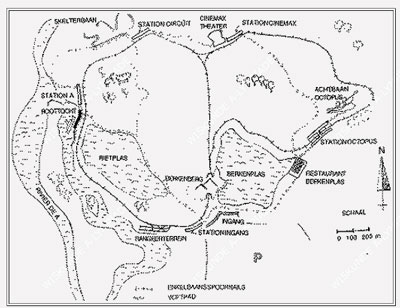 | 'De Berkenplas' Amusement Park The park was originally a nature park located by the river A, a few small lakes, and a hill with the sonorous name ‘De Berkenberg’. The ‘Berkenplas’ restaurant formed part of the park. A few years ago a businessman bought the nature park in order to turn it into an amusement park. As its natural state could not be disturbed to any great extent, the number of major attractions had to be kept limited. There is however space for adding a number of small attractions. When planning the lay out of the amusement park, the fact that some people want spectacular attractions (which often don’t last very long), while others will come for quiet recreation was taken into account. Because the distances in the park are rather large, and in order to give people the opportunity to easily see much of the landscape, it was decided to build a small railway line. Because of the natural obstacles of the landscape, this railway had to be a single track railway. It goes without saying that there are stations at the major attractions. The first two questions: Design the optimum timetable (for one day) for the three trains in the park. Management is considering building an extra landing stage for the boat (at the entrance) or buying two new carriages for the train but they are also open to other suggestions. Advise the management in this respect. Source Dutch version |
Background information
|
Math A-lympiad The Mathematics A-lympiad is a real-world-mathematics-problem-solving competition for teams of students forom uppe secondary schooles, with open ended assignments. The open assignments are designed by the A-lympiad committee, a committee residing at the Freudenthal Institute of Utrecht University in the Netherlands, that organizes the Mathematics A-lympiad since 1989. The aim is to elicit students to think mathematically, to solve open-ended unfamiliar problems in a creative way, to model, structure and represent problems and solutions, to work collaboratively and to communicate about mathematics. The task is set in a non-mathematical real life (often work related) situation that asks for mathematical modelling and problem solving. The final product is a report fitting the real-life context of the task. Math in teams During the Dutch Mathematics Day Contest students work in teams of about 3 to 4 members on an open mathematical problem solving task during a couple of hours. The product of this work is a report (and sometimes a presentation). |
Using your skills in a new setting
|
| Freudenthal Institute: Home - Utrecht University | Freudenthal Collection: Home - Showcase - Archive | Subset: Math A-lympiad |
