
The activity
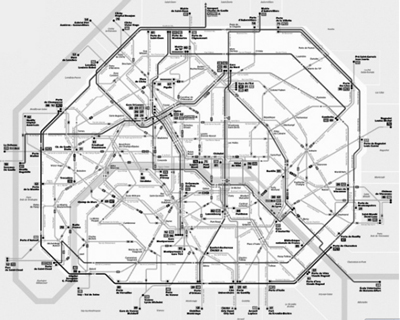 | Amberhavn Amberhavn is a typical European medium-sized old city; an authentic old city centre built around the cathedral, surrounded by more modern districts. Your team is going to create, by order of the local council, a plan for a new bus network. The other teams will also be working on this, and are of course your competitors! You will also test your own plan, and you have to develop a measure to judge the quality of the plans and to compare them. You will do this through four sub-assignments. You will find in attachment several street maps of Amberhavn. All sites of significance are pointed out on this map. The A3 maps can be used as worksheets. |
Background information
|
Math A-lympiad The Mathematics A-lympiad is a real-world-mathematics-problem-solving competition for teams of students forom uppe secondary schooles, with open ended assignments. The open assignments are designed by the A-lympiad committee, a committee residing at the Freudenthal Institute of Utrecht University in the Netherlands, that organizes the Mathematics A-lympiad since 1989. The aim is to elicit students to think mathematically, to solve open-ended unfamiliar problems in a creative way, to model, structure and represent problems and solutions, to work collaboratively and to communicate about mathematics. The task is set in a non-mathematical real life (often work related) situation that asks for mathematical modelling and problem solving. The final product is a report fitting the real-life context of the task. Math in teams During the Dutch Mathematics Day Contest students work in teams of about 3 to 4 members on an open mathematical problem solving task during a couple of hours. The product of this work is a report (and sometimes a presentation). |
Using your skills in a new setting
|
| Freudenthal Institute: Home - Utrecht University | Freudenthal Collection: Home - Showcase - Archive | Subset: Math A-lympiad |
